Mistletoe, often associated with holiday traditions, has a long-standing history in herbal medicine. Beyond its festive symbolism, particular species of mistletoe have been utilised in traditional remedies for various ailments.
In modern times, mistletoe extract has garnered attention as a complementary therapy in oncology, particularly in parts of Europe. Derived from the European mistletoe (Viscum album), these extracts are used alongside conventional cancer treatments to enhance quality of life and mitigate side effects.
While mistletoe therapy is not universally adopted and remains a topic of ongoing research, its integration into holistic treatment plans reflects a growing interest in combining traditional knowledge with contemporary medical practices.
What is Mistletoe?
Mistletoe is most known as a Christmas tradition and getting to kiss someone under it but it could potentially offer so much more.
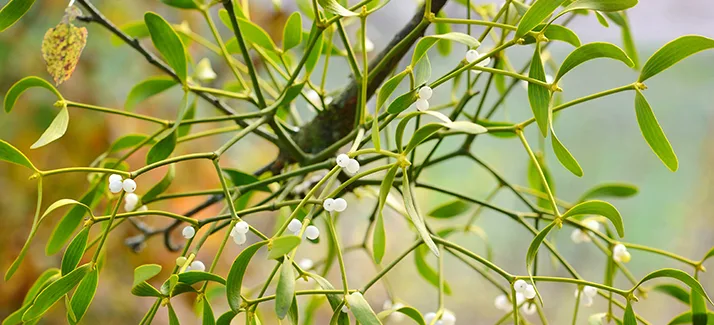
Mistletoe is a evergreen shrub which is semi-parasitic which means it needs another plant (its host) on supplying its water and some nutrients.
Mistletoe (Viscum album /Viscum L. / Viscum album L) belongs to the family of Viscaceae / Santalales/ Santalaceae /Loranthaceae.
Currently most popular species are mistletoe parasitising fir, maple, almond, birch, hawthorn, ash, apple, pine, poplar, oak, willow, lime and elm
History of Mistletoe Therapy
Mistletoe has a long and fascinating history that stretches far beyond holiday folklore. In ancient times, this semi-parasitic plant was revered by various cultures for its symbolic and medicinal qualities. The Celts and Druids considered mistletoe sacred—believing it to hold healing powers and spiritual significance, particularly when found growing on oak trees. It was often used in rituals to promote fertility, ward off evil, and treat a variety of ailments.
Medicinally, mistletoe has been used for centuries in European folk medicine to treat conditions such as epilepsy, hypertension, and nervous disorders. Its calming and circulatory effects were well known in traditional herbal practices across central and northern Europe.
The shift toward modern mistletoe therapy began in the early 20th century with the work of Rudolf Steiner, an Austrian philosopher and founder of anthroposophic medicine. Steiner proposed that mistletoe, with its unique growth pattern and parasitic nature, mirrored the behaviour of cancer cells and could be used as a therapeutic agent. In 1920, Steiner collaborated with physician Ita Wegman to develop the first mistletoe extract for cancer treatment, known as Iscador.
Since then, mistletoe therapy has become an established complementary cancer treatment in parts of Europe, especially in Germany and Switzerland. It is commonly used alongside conventional therapies such as chemotherapy and radiation to help improve quality of life, reduce fatigue, and enhance immune response.
While still considered alternative or investigational in many countries, the history of mistletoe therapy reflects a unique blend of traditional herbal wisdom and early integrative medical thinking, continuing to inspire interest and research in the field of complementary oncology today.
Mistletoe as Alternative Treatment
In recent decades, mistletoe has gained recognition as one of the most widely used complementary therapies for cancer in parts of Europe. While it is not a replacement for conventional treatments like surgery, chemotherapy, or radiation, mistletoe therapy is often used alongside standard medical care to support overall wellbeing and improve quality of life during treatment. Its role as an alternative treatment lies in how it addresses the whole person—physically, emotionally, and immunologically.
Mistletoe extract is believed to stimulate the immune system, helping the body better tolerate the side effects of aggressive treatments and potentially enhancing the body’s own capacity to respond to disease. Patients using mistletoe therapy have reported reduced fatigue, improved appetite, better sleep, and enhanced emotional balance, which can be profoundly valuable during the stress of a cancer journey.
What makes mistletoe unique in the alternative treatment landscape is the way it’s individually tailored. Different preparations and dosages are selected depending on the person’s condition, constitution, and stage of treatment. The therapy is typically administered via subcutaneous injections, and in some cases, intravenously under medical supervision. In Europe, especially Germany and Switzerland, anthroposophic doctors often include mistletoe therapy in integrative cancer care plans.
Though not yet widely accepted in mainstream medicine in many countries, clinical interest is growing. A number of studies have shown that mistletoe may improve health-related quality of life, reduce chemotherapy-related side effects, and, in some cases, even support survival outcomes when used as part of a broader treatment strategy. Ongoing research continues to investigate its mechanisms and effectiveness in different cancer types.
For individuals exploring gentler, plant-based therapies to complement conventional cancer care, mistletoe offers a bridge between nature and modern medicine, rooted in tradition and supported by evolving science.
Mistletoe could offer benefits and complementary treatment for:
Others hypertension, diabetes, liver diseases, epilepsy and Alzheimer’s disease
" The influence on fatigue especially should be investigated further"
This research shows a vast variety of potential uses or the use of Mistletoe: Biological activity of mistletoe: in vitro and in vivo studies and mechanisms of action
Mistletoe Therapy Research
Intravenous Mistletoe Treatment in Integrative Cancer Care
This study explores the use of intravenous mistletoe therapy (MT) in integrative oncology. It reports that MT can help stabilise disease, improve patients' general condition, vitality, strength, appetite, sleep, and reduce pain and fatigue. Additionally, it may enhance the tolerability of conventional cancer treatments.
Mistletoe and Immunomodulation: Insights and Implications for Anticancer Therapies
This review discusses how mistletoe extracts can modulate the immune system, potentially enhancing the body's ability to combat cancer. It highlights the role of mistletoe in stimulating immune responses and its implications for anticancer therapies.
Mistletoe in the treatment of cancer patients
This article examines the use of mistletoe extracts in cancer treatment, suggesting that they may improve survival and quality of life in cancer patients. It emphasises the need for further research to confirm these benefits
Mistletoe (Viscum album) preparations: an optional drug for cancer patients?
This study evaluates the potential of mistletoe preparations as an adjunct therapy for cancer patients. It discusses the immunomodulatory and cytotoxic effects of mistletoe, suggesting its possible role in cancer treatment.
Mistletoe-Extract Drugs Stimulate Anti-Cancer
Research indicates that mistletoe extracts can stimulate Vγ9Vδ2 T cells, a subset of immune cells with anticancer properties. This suggests a mechanism by which mistletoe may exert its therapeutic effects.
This comprehensive review assesses mistletoe extracts' effectiveness, tolerability, and safety in cancer therapy. It concludes that mistletoe therapy is commonly used and may offer benefits, but more rigorous studies are needed.
This study evaluates the safety of combining mistletoe therapy with immune checkpoint inhibitors in advanced cancer patients. The combination is generally safe, with adverse event rates comparable to those of immune checkpoint inhibitors alone.
Intratumoral Mistletoe (Viscum album L) Therapy in Patients With Unresectable Pancreas Carcinoma
A retrospective analysis suggests that intratumoral application of mistletoe may improve survival in patients with unresectable pancreatic cancer. However, the study emphasises the need for randomised controlled trials to confirm these findings.
This research compares adverse drug reactions (ADRs) incidence in patients starting mistletoe therapy at low versus high doses. It finds that higher initial doses are associated with a greater incidence of ADRs, suggesting that starting with lower doses may be safer.
Biological activity of mistletoe: in vitro and in vivo studies and mechanisms of action
This study explores the mechanisms by which mistletoe exerts its biological effects, including modulation of immune responses and induction of apoptosis in cancer cells. It underscores the complexity of mistletoe's actions and the need for further research.
This in vitro study assesses whether mistletoe extracts stimulate tumour growth. It concludes that mistletoe does not promote tumour growth in various human cancer cell lines, supporting its safety profile.
Mistletoe in immunology and the clinic
This short review discusses the immunological properties of mistletoe and its clinical applications. It highlights the role of mistletoe lectins in modulating immune responses and their potential therapeutic implications.
This case report describes a patient with melanoma metastases who achieved complete remission and long-term survival following high-dose mistletoe therapy. It suggests a potential role for mistletoe in treating advanced melanoma.
The case for mistletoe in the treatment of laryngeal cancer
This case study presents a patient with laryngeal carcinoma who recovered fully after mistletoe therapy, despite not responding to conventional treatments. It highlights the potential of mistletoe as an alternative therapy in certain cancers.
This article reports on two patients who experienced durable tumour regression after high-dose mistletoe therapy. It suggests that such dosing regimens may be effective in some instances.
Alternative Treatment Breast Cancer
This research assesses an integrative therapy approach, including mistletoe, in patients undergoing systemic therapy for breast or gynaecological cancer. It finds improvements inthe quality of life and reduced side effects.
Mistletoe: Neurological Disorders & Alzheimer's disease
This article reviews the chemical constituents of mistletoe and their potential therapeutic effects on central nervous system disorders. It emphasises the need for further studies to confirm these effects.
This article reviews the chemical constituents of mistletoe and their potential therapeutic effects on central nervous system disorders. It emphasises the need for further studies to confirm these effects.
Epilepsy
Sedative, antiepileptic and antipsychotic effects of Viscum album L. (Loranthaceae) in mice and rats
This animal study investigates the sedative, antiepileptic, and antipsychotic properties of mistletoe. It finds that mistletoe exhibits these effects in animal models, indicating potential for human applications.
Cancer and Fatigue
This systematic review examines the impact of mistletoe extracts on quality of life in cancer patients. It concludes that mistletoe may improve quality of life and reduce fatigue in these patients.
Clinical Trials Using Mistletoe
The first pilot randomised controlled trial is being carried out at University of Bristol with mistletoe therapy for breast cancer in the UK.
This pilot randomised, double-blind, placebo-controlled trial evaluated the feasibility of mistletoe therapy (Iscador M and Iscador P) in early-stage breast cancer patients undergoing chemotherapy, with or without radiotherapy. The study aimed to assess recruitment, retention, and acceptability of the intervention. Findings indicated that conducting such a trial in the UK is feasible, laying the groundwork for larger-scale studies to assess efficacy and safety.
This systematic review synthesized qualitative studies exploring cancer patients' experiences with mistletoe therapy. Patients reported improvements in physical, emotional, and psychosocial well-being, including reduced chemotherapy side effects and enhanced quality of life. The review highlighted the importance of patient-centered perspectives in evaluating complementary therapies.
This open-label, randomised phase III trial assessed the impact of Viscum album extract therapy on overall survival in patients with advanced pancreatic cancer. Results demonstrated a significant and clinically relevant prolongation of survival in the mistletoe-treated group compared to control, suggesting its potential as a non-toxic second-line therapy.
This multicenter observational study investigated the implementation of integrative oncology, including mistletoe therapy, in palliative care for advanced pancreatic cancer patients. The study found that combining mistletoe therapy with chemotherapy was associated with improved survival outcomes compared to chemotherapy alone, supporting its integration into palliative care strategies.
This randomized controlled trial evaluated the effect of mistletoe extract on the quality of life in patients with advanced pancreatic cancer receiving best supportive care. The study concluded that mistletoe treatment significantly improved quality of life measures compared to supportive care alone, highlighting its role in enhancing patient well-being.